Here's the new fledgling from our local Peregrine Falcons:
As well as the constant chatter of Chaffinches, at about 30 seconds you can hear the sound of some Black-headed Gulls overhead and the juvenile Peregrine ducks down and turns it head sideways to listen. Shortly after this it takes off and flies to a different location.


L.O.S. in the Park

The FOLP were asking members of the public to sign a petition which is lobbying for the park toilets to be refurbished, as well as many other improvements.

Click here for more fun day photos.

As well as this we took several youngsters and their parents on short guided bird watching walks along the new path at the edge of the woods. There wasn't too much about to see, but Dave Wilson is an expert on bird song and calls and so 12 bird species were identified in the area.

We made lots of new friends and contacts and have even arranged to do a presentation at 1st Astley Cubs next Thursday evening. We also hope to be doing another guided walk around Pennington Flash in the near future so keeping reading the website for details and have a look at our new LOSYBC calendar here.

BBC Radio 4 'Tweet of the Day'

These short 90 second programmes are available on the radio at the unearthly time of 5:58 am each day except on weekends. Fortunately, they are also available for downloading or listening to on the internet, and so I have linked to them here on our website:
BBC Radio 4 'Tweet of the Day' Home Page
BBC Radio 4 'Tweet of the Day' Programmes
In addition, the above BBC webpage link will appear on our side menu to the right as well as the last five programmes broadcast. The programmes here can be played by simply clicking on them.
We have a Winner !
After weeks of looking at all the excellent designs submitted by pupils from four local primary schools, the L.O.S. Young Birders' Club finally has a winner for our 'Design a Logo' competition. We're sorry this has taken a little longer than anticipated, but the standards were very high and it was difficult to choose just one winner.
The lucky winner is:
Well done Kimberley, the L.O.S. Young Birders' Team will also be visiting your primary school to present your prize soon. Here is Kimberley's logo and you will also be able to see it at the top of our LOSYBC webpages for the next year.

The lucky winner is:
Kimberley Butterworth
from St. Richard's Primary School
Well done Kimberley, the L.O.S. Young Birders' Team will also be visiting your primary school to present your prize soon. Here is Kimberley's logo and you will also be able to see it at the top of our LOSYBC webpages for the next year.
Some of the designs which gave us such difficulty in choosing are now available to see in our LOSYBC artwork gallery page here.
LOSYBC Easter Guided Walks at Pennington Flash
 |
| Sam Wade gets an eyeful of birds! |
The L.O.S. Young Birders' Club met at Pennington Flash for the second time on Easter Sunday. It was quite cold but very sunny and so the prospects for bird sightings were good. British Summertime had started in the early hours of this morning and so our 10am start was really still 9am for the birds!
 |
| Joan Disley talking to Mr Chapman about Frank Horrocks |
Armed with checklists and a set of identification photographs, the youngsters were all very keen to record as many birds as possible. Pairs of binoculars were lent to those who needed them and a scope was set up for viewing distant birds.
We actually spent far longer on the car park than anticipated but there were such a lot of birds to see on the Flash, including Goldeneye, Wigeon, Great Crested Grebe and Common Gull as well as the 'usual suspects' of Tufted Duck, Coot, Mallard, Mute Swans and Black-headed Gulls.
We were treated to an extended flypast by our resident Muscovy Duck (probably a collection or farmyard escapee) with two of the L.O.S.'s most experienced birders (David Wilson and Roy Rhodes) both saying that they'd never seen one fly so far before!
 |
| Did you see it? It went that way! |
Seven members of the L.O.S. were on hand to give help and guidance where needed, although it has to be said that some of the youngsters didn't need it.
We were all very surprised as a Gull quickly flew past and when asked what it was, Kristian quickly replied, "A Common Gull ". And after Roy Rhodes had checked it out with his scope, the young birder was proved to be absolutely correct!


Here's the full list of what we saw:
 |
| I hope you've got your sunglasses on! |
- Reed Bunting
- Willow Tit
- Bullfinch
- Greenfinch
- Dunnock
- Great Tit
- Blue Tit
- Chaffinch
- Robin
- Stock Dove
- Magpie
- Moorhen
That's 12 species from just one hide in no more than 15 minutes! Not bad, eh? The youngsters were fascinated watching the birds coming and going around the feeders and tables here - sometimes it was a hive of activity with many species on view at the same time, and then suddenly they flew away because something had spooked them, such as a loud noise or a nearby Sparrowhawk. It wasn't be long before they came back though.

And that was that - a very pleasant morning spent in the company of some enthusiastic young birders and their families. A total of 42 species were seen during our 2 hour tour of the hides.
If you're interested in coming on one of our guided walks, look in the 'Meetings' section of this website for details of the next one, which will be in late April or early May.
 |
| How can you tell it's Easter? |
P.S. You can click on any of the bird names in this report to find more information about each bird from the RSPB website.
L.O.S. at Leigh Library - Saturday 30th March

We'll be able to answer any questions you may have about the L.O.S. or our Young Birders' Club as well collecting names and e-mail addresses for our mailing list of future events.
So if you're in Leigh tomorrow morning, why not pop along to the Library and have a chat. We look forward to meeting you!

Well it was a little quiet at the Library for a Saturday (probably due to it being Easter weekend), but we met a few families who all seemed quite interested in the Young Birders' Club and several who said they would be at Pennington Flash tomorrow for the guided walks.
Thanks to Brian and Roy who helped man the stand with me for a few hours and thanks also to the staff at Leigh Library who were very helpful and accommodating.

St. Richard's R.C. Primary School Presentation
Our last series of primary school presentations before Easter have been at St. Richard's R.C. Primary School in Atherton. We visited the school twice to give our 'new style' presentations which split the feeding of birds from the their identification.
Our first session started with a Y4 class and later a Y5 class with George introducing Leigh Ornithological Society and explaining what the Society is and does and why we call it the L.O.S. (most of us can't even say Ornithological never mind spell it!). George then went on to tell the children why we're visiting schools, especially at this time of year, with details of how we call all help the birds in our gardens, parks and schools.
The presentation then began a discussion about which birds we are not likely to see locally such as Penguins, Ostriches, Hummingbirds and Golden Eagles with reasons as to why not. This was followed with a short quiz with photographs on some of the birds we should be able to see quite easily both locally and in our own gardens. There was a very good response from the children who were keen to answers questions and who also had many of their own.
Then it was time for the main activity which Brian explained and demonstrated very carefully and clearly to each of the classes.
The Y4 class made hanging seed feeders from a recycled plastic bottle by inserting two thin garden canes at right-angles for perches, poking holes around the middle of the bottle through which the birds can eat the seed and then threading some garden wire through the top to hang it up.
The Y5 class made some fatball feeders by cutting the bottom off a plastic bottle, making a hole in the side for the birds to eat the fatball and threading some garden wire through the top to hang it up.
The fatball was then placed inside with the netting removed so that the birds don't get trapped. This simple feeder is actually one of the quickest and most effective of all the ones we make.
After this Martyndescribed and demonstrated some of the best types of bird food to use in and around the feeders at home and in school. This included sunflower hearts, black sunflower seeds, nyger seed, fatballs, peanuts and monkey nuts, mealworms as well as mixed seed.
A tub of each type of food was shown to the children who were very interested in the different sizes, shapes and colours of each.
This section was completed by briefly mentioning that some birds prefer to eat off the ground or bird tables, whereas others eat by hanging from tree branches. More is done on this in the next session.
The first session was completed by Martyn who gave some details about the L.O.S. Young Birders' Club and website as well as our next planned guided walk around Pennington Flash - a letter was given out for the children to take home to their parents.
Finally the pupils were asked to design a new logo for our Young Birders' Club and told that it was a competition with a bird-related prize for the winner. But perhaps more importantly, the winning design will be used on the LOSYBC website and any other documents we produce.
Our second visit to St. Richard's was focused on bird identification. The main activity was to build a rotating Bird ID Dial and then use it to identify some birds from photographs.
Brian clearly demonstrated how to make the Bird ID Dial and explained how it could be used. He was very keen to emphasise that the cutting out should be done ''carefully, accurately and meticulously!"
After the demonstration the children worked in pairs to cut out the dial's two cardboard discs and then fasten them together with a split pin fastener.
When they had finished, Martyn went to explain that some birds feed mainly on the ground and other mainly by hanging from branches, although they both may sometimes do the opposite when food is short.
After a brief outline of many ground feeding birds, he described two of them in detail, the Blackbird and Chaffinch, with large colour diagrams projected on the whiteboard and then finished off with the songs that each bird makes. Brian then did the same for two hanging feeder birds, the Blue Tit and Goldfinch. The class really enjoyed seeing the drawings and hearing the different sounds
This identification section was completed by doing two quizzes based on bird photographs. In the the first quiz the children had to use what they had just learnt and their ID dials to identify some common garden birds from full photographs, writing their answers on a sheet.
The second quiz was a little harder, because only parts of the birds were shown in the photographs. A few pupils even went on to do a third quiz which was much harder than the first two.
 Risking life and limb, Martyn stood on the steps to hang up a group of four feeders outside the Y4 classroom so that it could be seen from their windows - the same was also done with the Y5 class. However, as it was quite cold and windy, it wasn't surprising that we didn't stay outside for very long!
It was a pleasure to visit St. Richard's because all the pupils and staff (Mrs King, Ms. Cunningham, Ms. McGhee and the Office Staff) were very welcoming and enthusiastic. We hope to go back again sometime to do a session on recording the birds we can see either on the feeders, or perhaps on a short fieldtrip somewhere.
Our first session started with a Y4 class and later a Y5 class with George introducing Leigh Ornithological Society and explaining what the Society is and does and why we call it the L.O.S. (most of us can't even say Ornithological never mind spell it!). George then went on to tell the children why we're visiting schools, especially at this time of year, with details of how we call all help the birds in our gardens, parks and schools.
 |
| Getting Started |
 |
| Making a hanging bottle seed feeder |
The Y4 class made hanging seed feeders from a recycled plastic bottle by inserting two thin garden canes at right-angles for perches, poking holes around the middle of the bottle through which the birds can eat the seed and then threading some garden wire through the top to hang it up.
 |
| A completed fatball feeder |
The fatball was then placed inside with the netting removed so that the birds don't get trapped. This simple feeder is actually one of the quickest and most effective of all the ones we make.
 |
| Martyn explaining bird foods |
A tub of each type of food was shown to the children who were very interested in the different sizes, shapes and colours of each.
This section was completed by briefly mentioning that some birds prefer to eat off the ground or bird tables, whereas others eat by hanging from tree branches. More is done on this in the next session.
 |
| Filling the seed feeder with seed |
Finally the pupils were asked to design a new logo for our Young Birders' Club and told that it was a competition with a bird-related prize for the winner. But perhaps more importantly, the winning design will be used on the LOSYBC website and any other documents we produce.
Our second visit to St. Richard's was focused on bird identification. The main activity was to build a rotating Bird ID Dial and then use it to identify some birds from photographs.
 |
| Brian's demonstration |
 |
| Carefully, accurately and meticulously! |
When they had finished, Martyn went to explain that some birds feed mainly on the ground and other mainly by hanging from branches, although they both may sometimes do the opposite when food is short.
After a brief outline of many ground feeding birds, he described two of them in detail, the Blackbird and Chaffinch, with large colour diagrams projected on the whiteboard and then finished off with the songs that each bird makes. Brian then did the same for two hanging feeder birds, the Blue Tit and Goldfinch. The class really enjoyed seeing the drawings and hearing the different sounds
 |
| Hard at work on the bird quiz |
The second quiz was a little harder, because only parts of the birds were shown in the photographs. A few pupils even went on to do a third quiz which was much harder than the first two.
The children all worked very hard on these quizzes and many got all the answers correct, so well done to all of you!
Our final activity was to go outside and hang up some of the feeders which the children made last week. A pair of step ladders was borrowed from the caretaker as well as a window pole to pull down some branches of a nearby tree.
 |
| Hanging the feeders |
 Risking life and limb, Martyn stood on the steps to hang up a group of four feeders outside the Y4 classroom so that it could be seen from their windows - the same was also done with the Y5 class. However, as it was quite cold and windy, it wasn't surprising that we didn't stay outside for very long!
It was a pleasure to visit St. Richard's because all the pupils and staff (Mrs King, Ms. Cunningham, Ms. McGhee and the Office Staff) were very welcoming and enthusiastic. We hope to go back again sometime to do a session on recording the birds we can see either on the feeders, or perhaps on a short fieldtrip somewhere.
Martyn Jones
Photo of the Week - Whiffling Geese
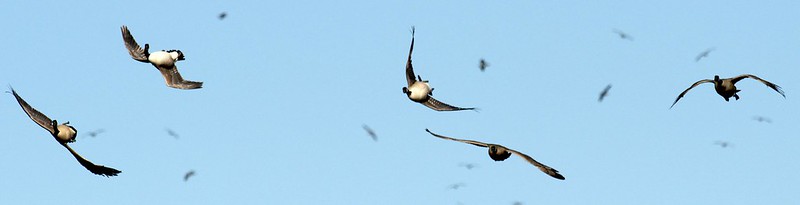 |
| Whiffling Canada Geese at Moore Nature Reserve in Warrington |
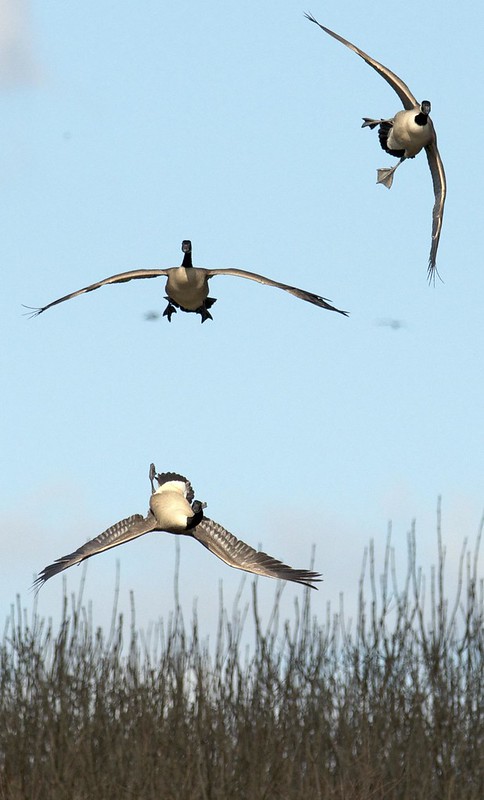 |
| Whiffling Canada Geese - (c) Martyn Jones |
Fieldtrip to Marbury Country Park – 10th March 2013.
Anyone who likes walking in an icy cold wind with snow blowing around would have loved this trip. Even so, the snow was only fine and didn’t stick on the ground, so it didn’t hold us up. However, when we arrived at the car park for Marbury Country Park it looked as though there was snow on some of the trees as the Blackthorn blossom was now open.
We made our way to the hide by the side of Budworth Mere and saw a number of smaller birds in this area, including four different members of the Tit family, Robin, Wren, Dunnock, Reed Bunting and Nuthatch. A Great Spotted Woodpecker was heard drumming, a Jay was seen and just behind us a Song Thrush was trying out its song. One of our members who had arrived well before we did had also seen Treecreeper and a Kestrel. The Mere itself gave us Great Crested Grebes, of which two birds were doing the head shaking part of their courtship display and we also saw Cormorant, Tufted Duck and a Grey Heron. A single Sand Martin which was flying round over the water must have been wondering if had it taken a wrong turn with the cold winds, snow and everything else it was having to face.
Onto Hayden’s Pool where we saw Lapwing, Teal, Gadwall, some more Tufted Ducks and it was near here that we had some good vies of a few Buzzards flying low as they took flight from the trees they had been perched in. The only other plants I saw in flower were some Gorse but all round there area I was seeing Cuckoo Pint, Ramsons and Bluebells leaves now through the ground and growing well, although as yet not in flower.
We moved to Neumann’s Flash for our last stop where we saw Shelduck, Shoveler, Mute Swans, Black-headed Gulls, a lot of which now had their dark heads, more Great Crested Grebes, Grey Heron and two Oystercatchers which flew past us.
On our way back to the start we managed to get a good look at a male Great Spotted Woodpecker on a dead tree and on a small pool was a single Black Swan by the side of two Mute Swans. As we watched these birds preening it gave us a good chance to compare the difference in size between the two species and could see how much smaller the Black Swan was.
Finally we arrived back at the car park and it was time for home but as we travelled back we could see hills in the distance now white on their tops with a covering of snow. Thanks to Al for organising the trip, Martin Ansell for his knowledge of this area and leading us round and to Martyn for my lift.
We made our way to the hide by the side of Budworth Mere and saw a number of smaller birds in this area, including four different members of the Tit family, Robin, Wren, Dunnock, Reed Bunting and Nuthatch. A Great Spotted Woodpecker was heard drumming, a Jay was seen and just behind us a Song Thrush was trying out its song. One of our members who had arrived well before we did had also seen Treecreeper and a Kestrel. The Mere itself gave us Great Crested Grebes, of which two birds were doing the head shaking part of their courtship display and we also saw Cormorant, Tufted Duck and a Grey Heron. A single Sand Martin which was flying round over the water must have been wondering if had it taken a wrong turn with the cold winds, snow and everything else it was having to face.
Onto Hayden’s Pool where we saw Lapwing, Teal, Gadwall, some more Tufted Ducks and it was near here that we had some good vies of a few Buzzards flying low as they took flight from the trees they had been perched in. The only other plants I saw in flower were some Gorse but all round there area I was seeing Cuckoo Pint, Ramsons and Bluebells leaves now through the ground and growing well, although as yet not in flower.
We moved to Neumann’s Flash for our last stop where we saw Shelduck, Shoveler, Mute Swans, Black-headed Gulls, a lot of which now had their dark heads, more Great Crested Grebes, Grey Heron and two Oystercatchers which flew past us.
On our way back to the start we managed to get a good look at a male Great Spotted Woodpecker on a dead tree and on a small pool was a single Black Swan by the side of two Mute Swans. As we watched these birds preening it gave us a good chance to compare the difference in size between the two species and could see how much smaller the Black Swan was.
Finally we arrived back at the car park and it was time for home but as we travelled back we could see hills in the distance now white on their tops with a covering of snow. Thanks to Al for organising the trip, Martin Ansell for his knowledge of this area and leading us round and to Martyn for my lift.
Jeff Hurst
Ynys-hir Trip Date Changes
Please note that the planned fieldtrip to Ynys-hir RSPN Nature Reserve has been changed to Wednesday 22nd May due to the proximity to the trip to Lesbos which only returns on the previous Saturday.
It's the place where a recent BBC Springwatch was filmed and should be a great day out. All are welcome but please remember it's an early start (7am) from Doctor's Nook Car Park.
It's the place where a recent BBC Springwatch was filmed and should be a great day out. All are welcome but please remember it's an early start (7am) from Doctor's Nook Car Park.
- Click this link for the Ynys-hir website: Ynys-hir Website
- Click this link for a downloadable map of the Yyns Hir Reserve: Ynys-hir Nature Reserve Map