L.O.S. Presentation - Friday 15th January

The Ken and Jean Gallimore Memorial Lecture
Great  Northern Diver in breeding plumage

In Search of Himbrini (The Great Northern Diver)
Gordon Yates

This presentation shows Gordon's three visits to Iceland before finally filming the Diver at the nest. Lots of other birds and Icelandic scenery are included. This is Gordon's 40th and final L.O.S. presentation so it should be a memorable evening.

Everyone is welcome and entry is free, so why not come along and join us?

PLEASE NOTE - THERE HAS BEEN A CHANGE OF DATE FOR OUR NEXT FRIDAY NIGHT PRESENTATION

Our next Friday night presentation in the Derby Room at Leigh Library will be on January 15th when Gordon Yates will be giving The Ken and Jean Gallimore Memorial Lecture entitled:

In Search of Himbrini


Himbrini is the Icelandic name for what we call the Great Northern Diver. This film shows my three visits to Iceland before finally filming the Diver at the nest. All Iceland's other birds and scenery are included on the way.
This talk has been rearranged from the previous date.

Bird of the Month - Waxwing

Species
Bohemian WaxwingBombycilla garrulus (the one we usually see)
Japanese WaxwingBombycilla japonica
Cedar WaxwingBombycilla cedrorum


Description
Waxwings are characterised by soft silky plumage. They have unique red tips to some of the wing feathers where the shafts extend beyond the barbs; in the Bohemian and cedar waxwings, these tips look like sealing wax, and give the group its common name. The legs are short and strong, and the wings are pointed. The male and female have very similar plumage.

All three species have mainly brown plumage, a black line through the eye and black under the chin, a square-ended tail with a red or yellow tip, and a pointed crest. The bill, eyes, and feet are dark. Calls are high-pitched, buzzing or trilling monosyllables

Diet
These are arboreal birds that breed in northern forests. (This for me is a fascinating bit of study)
Their main food is fruit, which they eat from early summer (strawberries, mulberries, and serviceberries) through late summer and autumn (raspberries, blackberries, cherries, and honeysuckle berries) into winter (juniper berries, grapes, crab apples, mountain ash fruits, rose hips, cotoneaster fruits, dogwood berries, and mistletoe berries)
They pluck fruit from a perch or occasionally while hovering.
In spring they replace fruit with sap, buds, and flowers. In the warmer part of the year they catch many insects by gleaning or in mid-air, and often nest near water where flying insects are abundant.

Movements
They are not true long-distance migrants, but wander erratically outside the breeding season and move south from their summer range in winter.
In poor berry year’s huge numbers can erupt well beyond their normal range, often in flocks that on occasion number in the thousands
The last time I managed to take pictures of this stunning bird was 1st January 2013 at Howe Bridge crematorium, Atherton. Examples below.

Text references from the internet, Collins Bird Guide, and The Birds of the Western Palearctic published by Oxford.


Poem by Velimir Khlebnikov
Where The Waxwings Used To Dwell
 
Where the waxwings used to dwell,
Where the pine trees softly swayed,
A flock of airy momentwills
Flew around and flew away.
Where the pine trees softly whooshed
Where the warblewings sang out
A flock of airy momentwills
Flew around and flew about.
In wild and shadowy disarray
Among the ghosts of bygone days,
Wheeled and tintinnabulated.
A flock of airy momentwills
A flock of airy momentwills!
You're warblewingish and beguilish,
You besot my soul like strumming,
Like a wave invade my heart!
Go on, ringing warblewings,

Long live airy momentwills!


Winter Thrushes

(Turdus pilaris & Turdus iliacus)

Every winter our fields, hedgerows and berry-bearing trees are inundated with ravenous visitors from the north. The invasion of these so-called Winter Thrushes descends on us like a plague beginning usually in mid-October but, dependant on weather conditions in Scandinavia and Russia, it’s sometimes earlier or later than this.


The European population of Fieldfare and Redwing that visit Britain are thought to be around three quarters of a million of each species but we also see other members of this family throughout our winter. Breeding populations of Song Thrush, Mistle Thrush and Blackbird tend to move southward to warmer climes but a good few hang on.  Our resident Blackbird numbers are bolstered by European migrants escaping the severe winter weather in their own breeding grounds.

The Fieldfare is just a little smaller than a Mistle Thrush and easily identified, the red/brown back is sandwiched between the battleship grey head and rump the contrast is clearly visible. Redwings are similar to Song Thrushes but the obvious buff stripes over the eyes and through the moustache are striking in appearance and the main identification factor when the bird is at rest or feeding. It is not until the bird is in flight that we see from whence came the name, (redwing) then you will notice the red underwing flashing like a red warning light as it rapidly flies away when disturbed.

European populations of Fieldfare and Redwing are thought to be in the region of 15 million breeding pairs for each species. Both species breed in many countries throughout the continent and have also been recorded as a rare breeding bird in Scotland, where a few pairs are successful each year. Throughout Britain’s countryside in winter large flocks of both these alert and wary species can be seen as they systematically strip the trees of their bounty.
David Shallcross
Information from a variety of publications including L.O.S. Newsletters


Update from the British Trust for Ornithology web site.


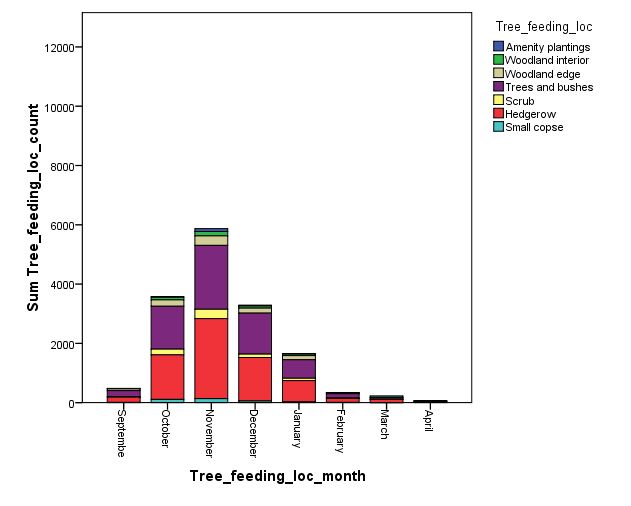
Graph 1
Figure 1: Tree and hedgerow feeding petered out during early
winter and ground feeding became dominant (see Fig 2).
(Click to enlarge)

Provisional results 2012/13 – a first look

Data collection for the survey's second and final winter is already in full swing. Meanwhile, we already have some tantalising provisional results that show the kind of new science that is hidden in the first winter's data. The two charts to the right are by no means a final conclusion: indeed there is a long way to go to tease out the complexities that are summarised here and work out the conclusions that can reliably be drawn.
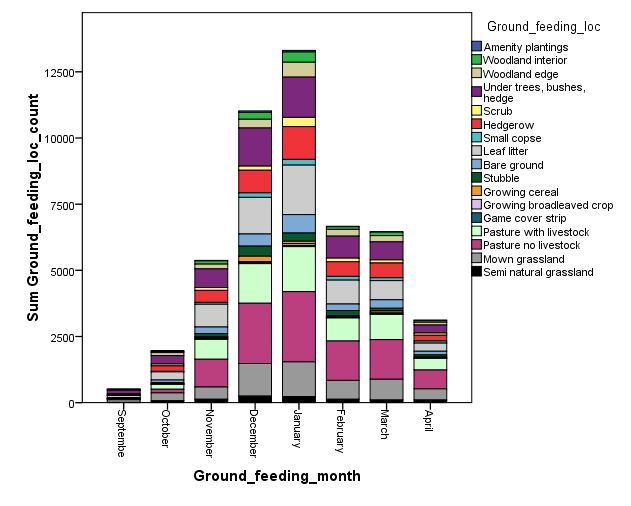
A major part of the analysis is likely to centre around the seasonal change from feeding in trees and bushes (Fig 1), which peaked in November, to feeding on the ground later in the winter (seen by comparing the timing of the peaks in Figs 1 & 2). This change was evident in all the thrush species and stems from their use of berries and fruits in hedgerows and trees until those supplies run low, followed by foraging on the ground, mainly for fallen fruit or for soil invertebrates. We are investigating how the timing of this change varies with species and region and your new data will show whether similar patterns will emerge in 2013/14.
Subdivisions of the bars on the histograms suggest rather little proportional change between feeding locations as winter progresses, other than between 'tree feeding' (Fig 1) and 'ground feeding' (Fig 2).
Graph 2
Figure 2: Ground feeding built to a peak in January
and dominated strongly into the spring.
(Click to enlarge)
Observations on foods taken by thrushes during the first winter of WTS also show seasonal changes that may relate to the ripening of fruits and berries and their subsequent depletion. The massive scale of WTS observations will allow us to document the winter feeding behaviour of thrushes in far more detail than ever before. And results of the core surveys, on randomly selected sites, will help us differentiate between observer and thrush location preferences.


L.O.S. Presentation - Friday 4th December

81 Degrees North - An Arctic Adventure
David Shallcross
A trip of a lifetime, David goes to Arctic Svalbard to see the amazing polar bears and enormous walrus, plus other specialist species of, birds, animals and flowers that are found there.

Friday 4th December sees L.O.S. Chairman Mr. David Shallcross give a talk about his recent trip to the Arctic region of Svalbard, in a presentation entitled "81 Degrees North - An Arctic Adventure.


David's show contains images of polar bears, walrus, seals, whales, reindeer, foxes and many bird species seen throughout his 16 day adventure of a lifetime.

We will see how the people past and present live, going to the edge of the pack ice just 500 miles from the North Pole, travelling down fjords and getting up close to Glacier fronts.


With hundreds of incredible photographs, this is truly one talk you don't want to miss. But please remember to wear something warm as the temperature is close to freezing, even in the summer!

So if you want to find out where Svalbard actually is, come along and join us in the Derby Room at Leigh Library this Friday (4th December). Doors open at 7:15pm for a 7:30pm start and everyone is welcome.

Fire Service incident at Pennington over the weekend

Leigh Ornithological Society (formed 1971)   

Hi all regarding the Fire Service incident at Pennington over the weekend, when rescue boats strayed into the reserve part of the water.

i emailed the station manager highlighting the disturbance caused. He was quick to reply and we have since had a discussion by telephone, to work out a protocol for future training so they don't coincide with either sailing regattas and most importantly monthly WeBS counting.

I will provided a contacts list for them, so hopefully it won't happen again.  Below is the Station Managers explanation (for security reasons i have removed his contact details)

Dear Mr Shallcross,

I have spoken to the crews involved in the training exercise on Pennington flash over the weekend, and they informed me that they had inadvertently strayed into the green marker buoys due to lack of knowledge of what this demarcation meant, upon this a safety vessel from the sailing club raced to the boat crew and informed them that they were in the nature reserve section of the flash, upon hearing these instructions they manoeuvred out of the area, also to my knowledge no crews purposely strayed into any environmentally delicate areas.

I can only apologise at any upset caused, and inform you that our crews would not intentionally cause distress to wildlife as this goes against what Firefighters and our Service represents.

The organiser of the training had tried numerous departments within Wigan Borough Council to ask for permission to use the flash, but he had no luck, if you have such contact details and would be kind enough to share these with me so we can ensure that this does not happen again I would be very appreciative.

The training coincidentally was to further enhance the skill sets of our boat crews for National and International deployments into flood stricken areas to render humanitarian services to people and animals in distress, I can assure you our crews are highly professional and sensitive to environmental issues.

If you are still unhappy with my response please do not hesitate to contact me and we can discuss this further.

Once again my apologies on behalf of Greater Manchester Fire & Rescue Service.

Kind regards        Station Manager
 
 
David Shallcross
Chairman, 

The Marsh Tit Locally and Regionally

Marsh Tit (c) RSPB
John Tymon's encounter with a Marsh Tit at Pennington Flash last week has prompted me to try to clarify the status of a species which has had a confusing history in several respects. To begin, it is clearly mis-named, since it has no affinity whatsoever with marshland, and its similarity to our more familiar Willow Tit has caused a degree of uncertainty about earlier records.


It wasn't even regarded as a separate species until the very end of the 19th century, by which time F.S.Mitchell's “The Birds of Lancashire” (1892) had been published and the accounts of both species had been placed together under the heading 'Marsh Tit'; many of these records would have been of Willow Tits and it wasn't until Clifford Oakes's “The Birds of Lancashire” appeared in 1953 that we have our first comprehensive accounts of the status of the two species. In this scholarly masterpiece, which I recommend to anybody with an interest in our regional ornithology, Mr. Oakes presents a description which includes its breeding range and names Silverdale as the place where the breeding population is most concentrated.

Willow Tit (c) RSPB
In his first paragraph, he produces a sentence which reflects our present-day understanding of its mobility outside the breeding season - “It is less inclined to wander during the winter (than the Coal Tit); indeed, its attachment to traditional nesting haunts may be one of the reasons for its failure to colonise otherwise suitable habitats.”

This disposition towards a sedentary existence is supported by an up-to-date reference on Wikipedia which states that UK ringing data indicates that 85% of over a hundred recoveries of ringed birds have been less than three miles from where they were ringed and only 1% more than twelve miles away. 

Clearly, the intriguing question must now be - “Has the bird that John saw last week come from some unknown local site, and, if so, where might that be?” I'll return to this question later : in the meantime, I leave you all with a beautifully enticing extract from Clifford Oakes - “There are few more pleasant sights than a party of 20-30 Marsh Tits, in fresh autumn plumage, feeding in birch or willow scrub at the forest edge on a sunny October day.” Interestingly, Mr. Oakes makes no mention of the Leigh area in his description of the Marsh Tit's breeding distribution, the nearest reference being “It is unknown near Bolton ….. “.

Marsh Tit
(c)  Stephen Burch
As regards local breeding in more up-to-date literature, two records probably refer to the same occurrence (somewhere in the Smithills/Doffcocker area) - “A very scarce resident. Only one pair known to have bred since 1980 (J.H.Cooper and J.C.Wood - “A Check List of the Birds of Bolton” c.1985”) “ and “The confirmed record near Bolton was unexpected” in “Breeding Birds in Greater Manchester (P.Holland, I.Spence and T.Sutton – MOS, 1984).”

Intriguingly, there are mixed messages from a well-watched site in the south of our recording area. In his 1981 publication “Birdwatching at Risley Moss”, Peter Barlow, a meticulous recorder of all he saw, did not include Marsh Tit in his list of species seen over several years, and yet there have been sightings on ten subsequent occasions (until 2013). Elsewhere, the situation a little later was concisely expressed in the Society's Report for 1990 by Chris Darbyshire - “One was identified near Pengy's hide at Pennington on 7th April. There were only seven accepted records of this South Lancashire rarity in our area during the 1980s, all in 1982-83: many claims were rejected due to lack of confirmatory detail and thus possible confusion with Willow Tit.”

Willow Tit at Pennington Flash
(c) Martyn Jones
In more recent years there have been a scattering of records more numerous to list here, but the earlier point about the Marsh Tit's sedentary nature brings me back to the point of local breeding. My available literature is somewhat contradictory, apart from the fact that mature woodland is an essential requirement, and I am inclined to request the help of highly-skilled naturalists, among them Pauline Greenhalgh and others who might be familiar with the Silverdale area or other strongholds, to perhaps give a brief habitat description to see if it fits any of our local sites, Borsdane or Atherton Woods, for example. 

The expert naturalist in our midst has, by way of experience and commitment, the ability to bring together birds and typical habitats in comments such as “This is a likely place for Lesser Whitethroat” or “Just let's see if there's a Jack Snipe here.” Perhaps a good habitat description might encourage some birdwatchers to visit unexplored corners and make an important discovery which might well lead to a site acquiring protective status on behalf of a Red List species such as Marsh Tit.

It might seem to be wishful thinking to connect John's sighting to a search of possible breeding habitats - to an important discovery - to the granting of protective status at a time when there are enormous pressures on all forms of wildlife. If such a sequence of events came to pass, it would be an invaluable and positive contribution towards local conservation at a time when much of the news about our environment is depressingly negative, and it would fulfil the two fundamental aims of our Society:-
  1. to further the study of birds in the field
  2. to assist in their preservation. 
Happy searching and good luck.
Dave Wilson

L.O.S. Members and Friends Evening - Friday 20th November

last shout for this folks need to know by saturday

Our annual Members and Friends Evening will be held at Leigh Rugby Union Club, Hand Lane, Pennington in Leigh. The proceedings will start at 7-30pm, so please arrive well before to get settled and buy a raffle ticket.

Food will be served around 8:30pm and will be traditional 'Pie un Peas' - a vegetarian option is available but must be pre-ordered by letting Tony Bishop know at the email address below.

A quiz will be active throughout the evening and marked near the end and there will be a 20 minute slide show of a recent visit to the Costa Blanca with a short interval of piano-accordion music and songs by Alan Prescott.
                                                           
All this for a fiver ... yes just £5 !!!

Please let Tony know you are coming as we need to order the food.
(leighos.vicechairman@gmail.com)


L.O.S. Presentation - Friday 6th November

Plains, Cranes and Autovia
Birding in Extremadura 
by Mike Roberts
Mike's talk is about the Steppe Region near Trujillo and the Park of Monfrague famed for its raptors. Bird species covered include Great and Little Bustard, Montagus Harrier and Spanish Imperial Eagles.

All L.O.S. presentation talks take place in the Derby Room at Leigh Library, from 7.15pm onwards.

Everybody is welcome so please come and join us.

L.O.S. Presentation - Friday 16th October

In Search of the Spoon-billed Sandpiper 
Wildlife of the Russian Far East
By Stephen Culley
In his presentation Stephen talks about a two week trip he made to the Russian Far East in summer 2014. This is a photographic journey showing some of the amazing scenery and wildlife, including bears, sea otters, whales, dolphins, Pacific auk colonies, Siberian Rubythroats and the critically endangered Spoon-billed Sandpiper on its breeding grounds.

Come and join us, all are welcome.

Please note that the L.O.S. 
AGM takes place before the presentation begins but this should be no more than about thirty minutes.