L.O.S. Presentation - Friday 5th February 2016


This is the fourth in the series of a 'Shot at Wildlife Images' that Pauline and Ian have produced, and includes lots of superb images of birds, flowers, fungi, insects, mammals and some breathtaking landscapes. All taken on their travels round the UK.

After our L.O.S. Open Day we're on a roll, so don't miss this one on Friday 5th February (yes it's February this week!). Usual place, the Derby Room at Leigh Library, usual time 7:15pm to 9:30pm, usual bunch of friendly welcoming people.

Everyone is welcome, especially our new members who joined last Saturday.

L.O.S. Open Day Thank-you

Where do I start? 
At the L.O.S. Open Day today the Derby Room was alive with enthusiastic bird and nature lovers all enjoying each other's company, meeting new people, put faces to names and learning about the work done by our local people. And Facebook has carried it on tonight with so many wonderful comments about how enjoyable the whole experience was for those who attended.
There are so many people to thank it's an almost impossible task, so I'll just have to say 'Thank-you Everybody' to whoever was involved in today, from the team of L.O.S. Committee members who supported me in organising this event, to the exhibitors who brought such wonderful photos and information displays and not forgetting all the members of the public who turned out in force. It certainly was a memorable experience for me and the comments which have followed on Facebook have made it all worthwhile. 
Thanks again, EVERYBODY!
Martyn Jones

Open Day Programme - Saturday 30 January 2016

Here's a pdf file of the final version of the programme for our Open Day on Saturday 30 January 2016.

This is what it looks like if the link doesn't work for you (it folds down the middle!)

L.O.S. Open Day Poster

Here's the L.O.S. Open Day poster that will be popping up in the hides at Pennington Flash and in various other places over the next couple of weeks:


Please feel free to print it out and display it somewhere suitable.

L.O.S. Open Day - Saturday 30th January 2016

Leigh Ornithological Society will be having an 'Open Day' in the Derby Room at Leigh Library from 11am to 3pm on Saturday 30th January 2016.  The main idea is to provide a time and place where anyone interested in birding, wildlife and nature can meet in an informal setting and have a good chat with each other.

We are very pleased that the event will be formally opened by Councillor Susan Loudon, the Mayor of Wigan Borough at 11am.

We do hope that many of the Manchester Birding Forum members and our Facebook friends will join us on this day and help us put faces to names, as many will have never met each other in person before. Entry will be free but you may like to help support Leigh Ornithological Society by becoming a member on the day or by making a small donation on the door.

There will be many L.O.S. members present with whom you'll be able to chat about where to go birding in the North West (and beyond) and what you might see there, as well as several invited guests who will be willing to talk about bird and nature photography, local conservation issues and anything else related to these topics. There will also be photographic displays and videos on topics such as bird identification and behaviour.

Our local nature photographers who will have projected displays of their work and who will be able to discuss their photographs, equipment and techniques include:
  • Pauline and Ian Greenhalgh - confirmed
  • John Barlow - confirmed
  • Dennis Atherton - confirmed
  • David Shallcross - confirmed
The following organisations and firms will be present with stalls and information boards:
  • Lancashire Wildlife Trust (Little Woolden Moss) - confirmed
  • Red Rose Forest - confirmed
  • Woolston Eyes Nature Reserve - confirmed
  • L.O.S. Young Birders' Club Team - confirmed
  • Trek Eco Adventures - confirmed
  • Friends of Low Hall Nature Reserve - confirmed
  • FAWN (Friends of Atherton Wildlife and Nature) - confirmed
I will have a display about Blue Tit nestbox cameras and information about how to put a live video feed on a website. There will also be a display on Tawny or Barn Owl nestbox cameras.

A selection of refreshments as well as second-hand books and some birding related products such as a few bird boxes and bird food will be available for purchase.  You will also be able to join the L.O.S. and possibly some of the other organisations on the day.

Please tell other people about this event and bring along a friend when you come.  If you live some distance from Leigh you can always tie-in a trip to Pennington Flash either before or after you've been to see us at Leigh Library.

So we do hope to see you there on Saturday 30th January to start the New Year with a Big Birding Bang!

Martyn Jones

Gordon Yates Bows Out After 43 Years

After 43 annual visits to the Leigh Ornithological Society, it looks like Gordon Yates is finally putting away his cine projector and incredible collection of birding and nature films for the last time.

Tonight we had another superb presentation by Gordon in the Derby Room, the spiritual home of the L.O.S., with a talk entitled 'In Search of Himbrini' (The Great Northern Diver).

Another L.O.S. legend, Dave Wilson, gave a sometimes humorous and informative vote of thanks, and Chairman David Shallcross presented Gordon with a bottle of his favourite Laphroaig Whisky from Islay along with honorary membership of the L.O.S. in recognition of the all the pleasure and enjoyment he has given to the Society over the years. All together a memorable evening which was attended by around fifty members and friends.


Here are quotes off Facebook by some of those who attended:

Pauline Mellor-Greenhalgh
I was on Gordon's shoulder all the way through tonight - literally and figuratively. I empathised his (and any) photographers doubts and fears ... will the bird be at this spot next year; if it is, am I too close to this bird now; is the weather going to change; am I going to be at the right distance when and if the sun finally shines. All us 'togs know, as Dave Wilson so aptly pointed out, we don't need long to achieve that near perfect shot - just a few seconds clicking with a still camera, as little as two minutes with a cine or video camera and it will be job done - in the bag!
Leading up to those few clicks or minutes can be a year - several years of waiting - hours of walking, searching, moving hides by a few feet for days on end. There are times when you would rather whip yourself with nettles than carry on with your quest, but that quest isn't going away - it calls to your subconscious all the time - you have to answer and go.
And for 40 odd years that we know of, Gordon has answered and responded and the end result of all the work, sweat, tears, joy, despair, every shade of emotion, finally devolves down into the finished film. Gordon you have my admiration,  every step of the way - thank-you.

David Shallcross (L.O.S. Chairman)
A very enjoyable evening, well attended and received by all I'm sure. Gordon has amazed us with his presentations over 40 years, and his enthusiasm and knowledge of his subjects is inspiring. He has given us not only entertainment but education on a wide range of fauna and flora. We have seen everything from our own local wildlife to moorland, heathland, coastal and estuarine habitats and the creatures that live there. 
We have been to every part of Great Britain and seen its wonders. We have been to places abroad and been fascinated by it all - tonight it was Iceland and the many trips, days and hours spent in pursuit of Gavia immer, the Great Northern Diver.  You have given us at Leigh Ornithological Society many brilliant evenings Gordon, who remembers "Symonds Yat to Muckle Flugga"? Entertainment, education and inspiration has been the theme running through your shows all these years.  
You thought they were just film shows, little did you know the effect your skill as a film maker and wildlife presenter had on many of your audience, me included. Dave Wilson gave a fitting vote of thanks tonight. which has to be the longest of all time, a 16 minute run down of the evening, the many presentations and the deep admiration we all hold for you as a friend of the Society. Many thanks indeed.

Steve Scrimgeour (and son)
Fantastic and educational presentation. (My 10 year old son) Joshua has already told his mum, he is off to Iceland. He has already pencilled next month on the calendar....
So it could be the end of an era, but remember Frank Sinatra?

L.O.S. Presentation - Friday 15th January

The Ken and Jean Gallimore Memorial Lecture
Great  Northern Diver in breeding plumage

In Search of Himbrini (The Great Northern Diver)
Gordon Yates

This presentation shows Gordon's three visits to Iceland before finally filming the Diver at the nest. Lots of other birds and Icelandic scenery are included. This is Gordon's 40th and final L.O.S. presentation so it should be a memorable evening.

Everyone is welcome and entry is free, so why not come along and join us?

PLEASE NOTE - THERE HAS BEEN A CHANGE OF DATE FOR OUR NEXT FRIDAY NIGHT PRESENTATION

Our next Friday night presentation in the Derby Room at Leigh Library will be on January 15th when Gordon Yates will be giving The Ken and Jean Gallimore Memorial Lecture entitled:

In Search of Himbrini


Himbrini is the Icelandic name for what we call the Great Northern Diver. This film shows my three visits to Iceland before finally filming the Diver at the nest. All Iceland's other birds and scenery are included on the way.
This talk has been rearranged from the previous date.

Bird of the Month - Waxwing

Species
Bohemian WaxwingBombycilla garrulus (the one we usually see)
Japanese WaxwingBombycilla japonica
Cedar WaxwingBombycilla cedrorum


Description
Waxwings are characterised by soft silky plumage. They have unique red tips to some of the wing feathers where the shafts extend beyond the barbs; in the Bohemian and cedar waxwings, these tips look like sealing wax, and give the group its common name. The legs are short and strong, and the wings are pointed. The male and female have very similar plumage.

All three species have mainly brown plumage, a black line through the eye and black under the chin, a square-ended tail with a red or yellow tip, and a pointed crest. The bill, eyes, and feet are dark. Calls are high-pitched, buzzing or trilling monosyllables

Diet
These are arboreal birds that breed in northern forests. (This for me is a fascinating bit of study)
Their main food is fruit, which they eat from early summer (strawberries, mulberries, and serviceberries) through late summer and autumn (raspberries, blackberries, cherries, and honeysuckle berries) into winter (juniper berries, grapes, crab apples, mountain ash fruits, rose hips, cotoneaster fruits, dogwood berries, and mistletoe berries)
They pluck fruit from a perch or occasionally while hovering.
In spring they replace fruit with sap, buds, and flowers. In the warmer part of the year they catch many insects by gleaning or in mid-air, and often nest near water where flying insects are abundant.

Movements
They are not true long-distance migrants, but wander erratically outside the breeding season and move south from their summer range in winter.
In poor berry year’s huge numbers can erupt well beyond their normal range, often in flocks that on occasion number in the thousands
The last time I managed to take pictures of this stunning bird was 1st January 2013 at Howe Bridge crematorium, Atherton. Examples below.

Text references from the internet, Collins Bird Guide, and The Birds of the Western Palearctic published by Oxford.


Poem by Velimir Khlebnikov
Where The Waxwings Used To Dwell
 
Where the waxwings used to dwell,
Where the pine trees softly swayed,
A flock of airy momentwills
Flew around and flew away.
Where the pine trees softly whooshed
Where the warblewings sang out
A flock of airy momentwills
Flew around and flew about.
In wild and shadowy disarray
Among the ghosts of bygone days,
Wheeled and tintinnabulated.
A flock of airy momentwills
A flock of airy momentwills!
You're warblewingish and beguilish,
You besot my soul like strumming,
Like a wave invade my heart!
Go on, ringing warblewings,

Long live airy momentwills!


Winter Thrushes

(Turdus pilaris & Turdus iliacus)

Every winter our fields, hedgerows and berry-bearing trees are inundated with ravenous visitors from the north. The invasion of these so-called Winter Thrushes descends on us like a plague beginning usually in mid-October but, dependant on weather conditions in Scandinavia and Russia, it’s sometimes earlier or later than this.


The European population of Fieldfare and Redwing that visit Britain are thought to be around three quarters of a million of each species but we also see other members of this family throughout our winter. Breeding populations of Song Thrush, Mistle Thrush and Blackbird tend to move southward to warmer climes but a good few hang on.  Our resident Blackbird numbers are bolstered by European migrants escaping the severe winter weather in their own breeding grounds.

The Fieldfare is just a little smaller than a Mistle Thrush and easily identified, the red/brown back is sandwiched between the battleship grey head and rump the contrast is clearly visible. Redwings are similar to Song Thrushes but the obvious buff stripes over the eyes and through the moustache are striking in appearance and the main identification factor when the bird is at rest or feeding. It is not until the bird is in flight that we see from whence came the name, (redwing) then you will notice the red underwing flashing like a red warning light as it rapidly flies away when disturbed.

European populations of Fieldfare and Redwing are thought to be in the region of 15 million breeding pairs for each species. Both species breed in many countries throughout the continent and have also been recorded as a rare breeding bird in Scotland, where a few pairs are successful each year. Throughout Britain’s countryside in winter large flocks of both these alert and wary species can be seen as they systematically strip the trees of their bounty.
David Shallcross
Information from a variety of publications including L.O.S. Newsletters


Update from the British Trust for Ornithology web site.


Graph 1
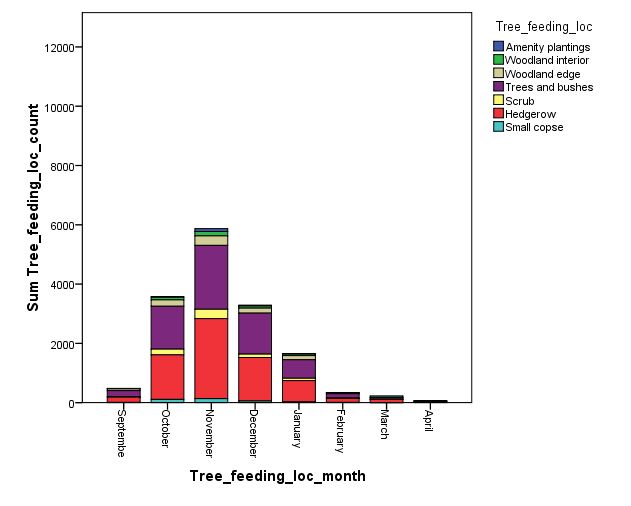
Figure 1: Tree and hedgerow feeding petered out during early
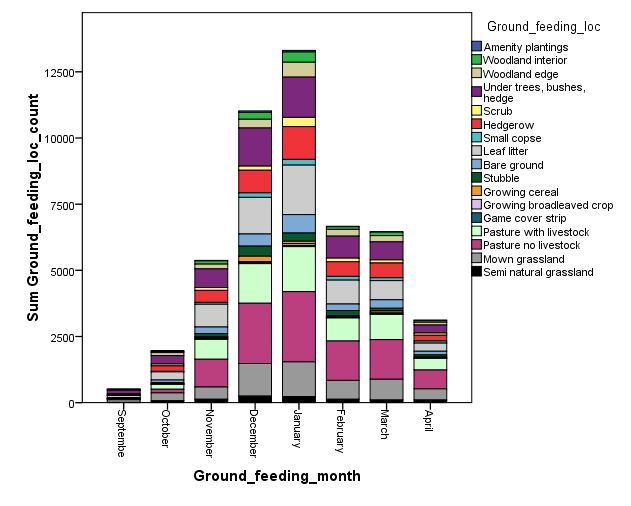
winter and ground feeding became dominant (see Fig 2).
(Click to enlarge)

Provisional results 2012/13 – a first look

Data collection for the survey's second and final winter is already in full swing. Meanwhile, we already have some tantalising provisional results that show the kind of new science that is hidden in the first winter's data. The two charts to the right are by no means a final conclusion: indeed there is a long way to go to tease out the complexities that are summarised here and work out the conclusions that can reliably be drawn.
A major part of the analysis is likely to centre around the seasonal change from feeding in trees and bushes (Fig 1), which peaked in November, to feeding on the ground later in the winter (seen by comparing the timing of the peaks in Figs 1 & 2). This change was evident in all the thrush species and stems from their use of berries and fruits in hedgerows and trees until those supplies run low, followed by foraging on the ground, mainly for fallen fruit or for soil invertebrates. We are investigating how the timing of this change varies with species and region and your new data will show whether similar patterns will emerge in 2013/14.
Subdivisions of the bars on the histograms suggest rather little proportional change between feeding locations as winter progresses, other than between 'tree feeding' (Fig 1) and 'ground feeding' (Fig 2).
Graph 2
Figure 2: Ground feeding built to a peak in January
and dominated strongly into the spring.
(Click to enlarge)
Observations on foods taken by thrushes during the first winter of WTS also show seasonal changes that may relate to the ripening of fruits and berries and their subsequent depletion. The massive scale of WTS observations will allow us to document the winter feeding behaviour of thrushes in far more detail than ever before. And results of the core surveys, on randomly selected sites, will help us differentiate between observer and thrush location preferences.