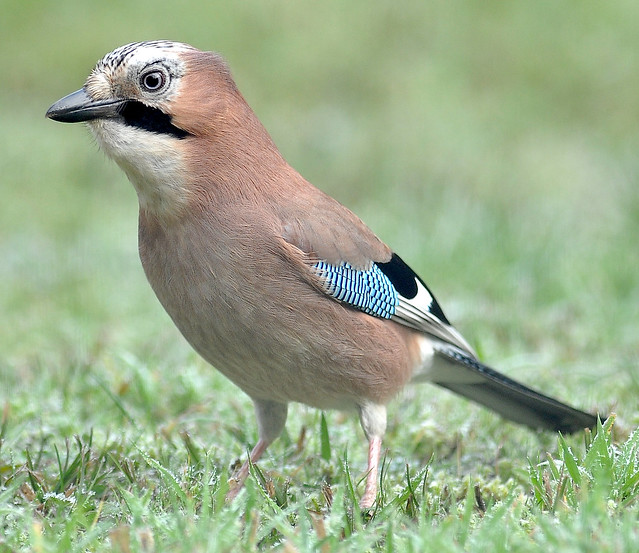
I thought I'd start a 'Photo of the Week' section off today so that LOS members can show us what they've been up to in between meetings and fieldtrips. I'll get the ball rolling with a photo of a Jay taken today in my Tyldesley back garden through closed patio windows:
If you have a photo which you'd like to see published here, just e-mail it to me at leighos.webmaster@gmail.com and if you have a Flickr site, send me the address and I'll add it to our website.
L.O.S. Members' Evening
Just a quick reminder that this Friday (23rd November) is L.O.S. Members' Night from 7:30pm onwards at the Rugby Club in Leigh. There will be a buffet at £4 per head payable on the night and a presentation of birding photographs will be given by L.O.S. Chairman David Shallcross.
If you haven't booked a place yet please get in touch with either David or Tony for ticket availability.
Would all those members who are attending please consider bringing a small prize for the raffle which contributes to the Society's funds. A great night will be had by all.
If you haven't booked a place yet please get in touch with either David or Tony for ticket availability.
Would all those members who are attending please consider bringing a small prize for the raffle which contributes to the Society's funds. A great night will be had by all.
L.O.S. receives WBHN 2012 Award
The Society has been recognised by Wigan Borough Environmental Heritage Network for its contribution to the promotion of the Borough’s local environment and heritage.
The award was received on behalf of the Society by Chairman David Shallcross and Vice Chairman Tony Bishop. The Society is represented at Network meetings by honorary member Dave Wilson, David and Tony.
At the event David and Tony gave a slide presentation showing how Pennington Country Park was formed by coal mining subsidence, and how it has developed over time to its present status.
David Shallcross
Ornithology and Conservation in the Leigh District 1938-1956
LOS Conservation Officer Roy Rhodes has provided this link to the LeighLife website on which there is information by Tom Edmondson about the history of birding in the Leigh area from his perspective.
On the same website there is also a collection of photos and cuttings about the chequered history of Pennington Flash and the flooding which used to occur and that seems relevant too. There is also a section on what was then called 'Astley Flash' east of the tip at Astley Green.
I've only scanned it at present, but I think I'll be printing it out as it looks a really interesting read to find out what the birding and habitat was like in the past. Here's the link again to make sure you don't miss it!
Ornithology and Conservation in the Leigh District 1938-1956
On the same website there is also a collection of photos and cuttings about the chequered history of Pennington Flash and the flooding which used to occur and that seems relevant too. There is also a section on what was then called 'Astley Flash' east of the tip at Astley Green.
I've only scanned it at present, but I think I'll be printing it out as it looks a really interesting read to find out what the birding and habitat was like in the past. Here's the link again to make sure you don't miss it!
Ornithology and Conservation in the Leigh District 1938-1956
Peat Extraction at Chat Moss Refused!
LOS Treasurer Raymond Meredith, who is a volunteer for the Lancashire Wildlife Trust, has forwarded this e-mail about the peat extraction at Chat Moss:
This is great news for all who signed the e-petition.
Hi Everyone,
Fantastic news! We have just heard, after a very long fight, that the appeal to allow more peat extraction on Chat Moss has been refused! A huge well done to everyone involved in such a long and difficult campaign. Although this is just one site, we have high hopes for this to become a test case for the rest of the country and possibly beyond!
You can read the news story here:
http://www.lancswt.org.uk/news/293/15/Wildlife-Trust-joy-over-peat-extraction-ban
You can read the news story here:
http://www.lancswt.org.uk/news/293/15/Wildlife-Trust-joy-over-peat-extraction-ban
Lindsey
Lindsey Poole
Marketing and Communications Manager
The Wildlife Trust for Lancashire, Manchester and North Merseyside
Marketing and Communications Manager
The Wildlife Trust for Lancashire, Manchester and North Merseyside
Birds of the Wayoh, Turton and Edgworth Reservoirs
![]() |
| Barn Owl with a kill |
John has been a birder since he was eight years old and as he is now in his 40's, he has amassed a great wealth of experience in the field. Indeed in this area alone he and fellow local bird photographer Clifford Heyes have recorded no less than 132 species from 1980 until today.
![]() |
| A classic Nuthatch shot |
John only bought his first digital DSLR camera in 2010 and so he is very reluctant to call himself a bird photographer yet. However the sheer quality of his photographs belies this and we think he does himself a great disservice.
![]() |
| Kestrel hunting Sand Martins |
He also told us a funny story about the time a Whinchat kept perching on his head whilst he was wearing a camouflaged drape and so he couldn't actually get a photograph of it!
John clearly spends a long time setting up his shoots and will often visit a site many times to get a good photograph. He is very lucky to live close the reservoirs in the Wayoh area, and so he's able to get out there fairly often.
One of John's interests is shooting birds with man-made objects (often rubbish or other discarded items) or in human environments.
This is something that many photographers would try their best not to do, but John manages to get some quirky images in doing so and it is rapidly becoming one of his 'hallmark' styles.
Here's a humorous photo of a Little Owl on an electricity pylon - he clearly can't read!
The photographs featured here are all from John's website John Barlow Photography where all the images shown at tonight's presentation can be seen again. In addition, greetings cards and charity calendars featuring his photographs can be previewed and bought.
The presentation was finished off with a traditional sunset image: a fantastic photo of Darwen Tower.
A great presentation by a nice chap with stunning photographs - what more could you want for an evening out?
Martyn Jones
Please feel free to leave a comment about this post by clicking on the word Comment below this line and following the instructions which appear.
Join the BTO for £1
As a BTO member you will receive the full welcome pack, copies of the BTO magazine every other month, 20% discount on Bird ID and survey techniques training courses and contact with your regional BTO representative.
With more members the BTO could do so much more of the survey and science work that is so important for informing conservation.
Burton Mere Wetlands Trip – 7th October 2012
It was a cool damp and misty start to the day but as the mist cleared we were left with a lovely sunny day. Unfortunately this is not always the best weather in which to go birding as we shall see ...
Our first stop was at the RSPB reserve at Burton Mere Wetlands and when we arrived we were met with the wonderful sight of a good sized group of Shaggy Inkcap fungi growing in the car park. The other good thing about this was the way they had their own parking place as they were growing neatly within the markings put down for a vehicle. Another fungus we saw later was Sulphur Tuft although looking more of an orange colour as it was now past its best.
As we were trying to photograph the Inkcaps we could hear a Buzzard not far away and soon saw a Nuthatch. A little later this bird could be seen making regular visits to some feeders which were also attracting various members of the Tit family plus Chaffinch and Goldfinch.
These feeders were also favourites of two Brown Rats that kept coming out to feed on the seed that had spilled to the ground. As we were leaving I noticed some more feeders on the other side of the path and under these were five rats feeding. Around the first hide we saw Tufted Duck and two Little Grebes, one of these being a full sized young bird now as big as the adult bird that was feeding it. Other more common birds were Coot, Moorhen and Canada Geese.
While walking to the furthest hide we could still see the last few flowers on the Alkanet and Red Campion but Jim and I stopped for a few minutes to take in the perfect mirror reflections of some reeds and trees in the still water of one of the pools.
As we were looking at this, two Grey Wagtails flew across the far end of the water, shortly to fly back across the reeds the other way. This was repeated several times with the birds sometimes landing out of view, other times one might land on one of the tree branches that were overhanging the water.
At the far hide birds such as Reed Bunting were seen as was Shoveler, Gadwall and in waders Ruff, Snipe and Black-tailed Godwit.
But it was now time to move on and as we walked back to the car park we managed to see the day's only butterfly when we watched a Small Tortoiseshell for a few minutes on a Thistle.
![]() |
| Shaggy Inkcap (Joan Disley) |
As we were trying to photograph the Inkcaps we could hear a Buzzard not far away and soon saw a Nuthatch. A little later this bird could be seen making regular visits to some feeders which were also attracting various members of the Tit family plus Chaffinch and Goldfinch.
These feeders were also favourites of two Brown Rats that kept coming out to feed on the seed that had spilled to the ground. As we were leaving I noticed some more feeders on the other side of the path and under these were five rats feeding. Around the first hide we saw Tufted Duck and two Little Grebes, one of these being a full sized young bird now as big as the adult bird that was feeding it. Other more common birds were Coot, Moorhen and Canada Geese.
![]() |
| Distant Ruff (Martyn Jones) |
As we were looking at this, two Grey Wagtails flew across the far end of the water, shortly to fly back across the reeds the other way. This was repeated several times with the birds sometimes landing out of view, other times one might land on one of the tree branches that were overhanging the water.
![]() |
| Small Tortoiseshell Butterfly (Joan Disley) |
But it was now time to move on and as we walked back to the car park we managed to see the day's only butterfly when we watched a Small Tortoiseshell for a few minutes on a Thistle.
After going back to the visitor centre, some members decided to take the short walk to the viewing screens on the other side of the reserve.
There was not much to be seen here except for a distant bird of prey. We debated for at least 20 minutes about whether it was a Merlin or an immature Kestrel and I'm not sure what we actually settled on in the end! It was a very long way off and the heat haze didn't help when looking through a scope. After giving it very careful consideration, a local photographer however did say he thought it was a Merlin, so we'll go with that.
After a quick drink back at the car park, a short drive brought us round to the Inner Marsh Farm which is the original RSPB site here. As we ate our sandwiches in the small car park, we could see a Pied Wagtail on the roof of the old farm building.
Instead of this site, some of our members went onto Denhall Lane which overlooks Burton Marsh, where they saw a Hen Harrier, Buzzard and another Kestrel plus a pair of Stonechat as well as a Green Woodpecker flying up from the marsh and over to the nearly trees.
When the two parties met up again only the Stonechat, Kestrel and a Buzzard were showing, as well as a single Robin.
We then went onto Parkgate, a little further up the Wirral coast but this is much the same sort of area and unfortunately these days it's so silted up and overgrown with saltmarsh vegetation you can’t even see the water anymore, it's that far away.
However, we did manage to see a Little Egret, Heron, a Cormorant flying past and another Kestrel, so these birds seem to be doing very well in this area.
A Skylark was also heard and one last bird especially for Eric was the Black-headed Gull which he is very keen to be notfied about if you see any.
Thanks once again to Al for organising the trip and to Eric for the lift.
Martyn and Sarah actually continued on to Red Rocks at Hoylake and finally Leasowe Lighthouse at the 'top' of the Wirral to see what the high tide had brought in. Although the tide didn't seem to be very far in at Red Rocks there were decent views of Oystercatchers, Curlew, Sanderling and various Gulls. At Leasowe the tide was fully in and lapping on the promenade walls, so we were a little late as it's best to get there an hour or so before the high tide. However, using a scope on some sandbanks which were exposed, there were decent views of all the birds seen at Red Rocks in much greater quantities (such as a few hundred Oystercatchers) as well as Ringed Plovers and the occasional Turnstone.
There was not much to be seen here except for a distant bird of prey. We debated for at least 20 minutes about whether it was a Merlin or an immature Kestrel and I'm not sure what we actually settled on in the end! It was a very long way off and the heat haze didn't help when looking through a scope. After giving it very careful consideration, a local photographer however did say he thought it was a Merlin, so we'll go with that.
![]() |
| Pied Wagtail (Martyn Jones) |
There is usually more to see from the hide here and with better views as you are not looking directly into the sunshine. However, this time most of what we could see in front of the hide was Teal and Lapwings. As we arrived at the hide we were met by a flyover of some of the Greylag Geese and while in the hide we spotted two Redshank near the edge of the water.
Our attention was then drawn to a Kestrel on the ground that looked to be eating something until another Kestrel flew in and they started to fight over whatever was on the menu. Here I also spotted the last few flowers on a Foxglove plant and a cluster of bright red shiny berries on a Bittersweet plant.
![]() |
| Female Stonechat (Martyn Jones) |
When the two parties met up again only the Stonechat, Kestrel and a Buzzard were showing, as well as a single Robin.
![]() |
| A Burton Mere Kestrel (Martyn Jones) |
| Black-headed Gulls for Eric |
A Skylark was also heard and one last bird especially for Eric was the Black-headed Gull which he is very keen to be notfied about if you see any.
Thanks once again to Al for organising the trip and to Eric for the lift.
Jeff Hurst
-----------------------------------------------------------------------------------------------------------------------------------------------
Addendum
Addendum
![]() |
| Leasowe Lighthouse - built in 1763 |
Martyn Jones
Spurn Point Trip - 2nd September 2012
![]() |
| Location of Spurn point on the Humber Estuary |
However, we did do a lot better with the weather than expected as we had sunshine which had not been promised so it ended up quite warm.
From the car park and in fact all day there were a lot of Swallows flying round and also a number of House Martins. On one nearby building there was a whole line of House Martin nests just under the eaves along its front and we saw a few birds still entering the nests.
We had Pied Wagtail and later Joan saw a Grey Wagtail; House Sparrow and a number of Starlings were seen through the day.
As we walked along a path, heading for a distant pool all we were seeing were birds such as Blue Tit, Great Tit and Blackbird but we did eventually see Linnet and a few members saw a Wheatear perched on a fence when level with a gap in the hedge.
![]() |
| Spurn Point from the air |
After we had eaten we planned to drive along to the far end of the “point” but this didn’t work out as the road was closed because it had been damaged due to bad weather.
We then decided to walk part way along the road to see what was on the estuary side but as the tide was out all the birds were spread out over a large area and a lot of the time we were looking into the sunshine so didn’t have a good view of the ones nearer to us.
What we did pick out were Curlew, a number of Golden Plover, Ringed Plover, the odd Turnstone, a lot of Shelduck, 2 Little Egrets and a single Swift flew past us.
At least the sunshine brought out other things of interest such as some Common Blue butterflies and earlier we had seen Small Tortoiseshell and Peacock. Also earlier Eddie spotted 2 small lizards enjoying the warmth of the sun. From their small size and dark colour I would think they were young ones. A quick check in another usual spot for birds but this again gave us nothing so we decided to head for home as it was a long journey back.
Thanks to Al for organising the trip and of course to Joan and Jim for a safe journey both ways.
Jeff Hurst
Lancashire Bird Report 2011
Copies of the Lancashire Bird Report for 2011 are now available priced only £6 from Mere Sands Wood Nature Reserve and Brockholes Nature Reserve.
Alternatively, please contact Raymond Meredith at any LOS Derby Room Meeting on a Friday night, such as the one next week.
Next week's presentation is 'Northumberland Through the Seasons' by Tim Melling. Doors open at 7:15pm for a 7:30pm start and everyone is welcome.
Please note that a nominal door charge of £2 is applicable to non-members.
Alternatively, please contact Raymond Meredith at any LOS Derby Room Meeting on a Friday night, such as the one next week.
Next week's presentation is 'Northumberland Through the Seasons' by Tim Melling. Doors open at 7:15pm for a 7:30pm start and everyone is welcome.
Please note that a nominal door charge of £2 is applicable to non-members.